
Blog: Neighbourhood leadership and flock theory
By Duncan Gooch, Chair, NHS Confederation’s Primary Care Network | General Practitioner at West Park Surgery
At the recent NHS Confederation Care Closer to Home conference I had a bit of fun in the plenary session chaired by the wonderful Lord Victor Adebowale CBE. I introduced a metaphor I have been working on.
Stay with me.
In behavioural science (also described through the Boids model or swarm intelligence), flocks of birds demonstrate complex, organised movement without central command. There is no master bird directing traffic. Instead, order emerges because each bird follows three simple local rules:
- Separation – don’t fly too close to those around you
- Alignment – move in the same direction and speed as your neighbours
- Cohesion – head towards a common goal
From these local interactions comes something extraordinary: the murmuration. Fluid. Adaptive. Highly coordinated. No central control — yet deeply organised.
I can’t help thinking that neighbourhoods feel remarkably similar.
A neighbourhood is a flock of assets: the public, VCSE, general practice, community services, social care, local government and others. Each retains autonomy. Each can change direction. Each responds primarily to what is immediately around them.
Yet when aligned around a shared purpose, something powerful emerges.
Where we sometimes go wrong is in how we interpret leadership.
Too often, leadership in neighbourhoods is framed as control. A larger organisational “bird” enters the system — often well-intentioned — attempting to steer or standardise. But in nature, when a large bird approaches a flock, the murmuration shifts shape. The priority becomes safety and distance, not destination.
I see parallels in our system. When the NHS (or any dominant partner) behaves like the “big bird”, neighbourhood actors instinctively create space. Energy diverts into protection rather than progress. The shared goal — improving population health — becomes secondary to self-preservation.
So what does leadership look like instead?
Flock theory gives us clues.
In a flock, coordination is local. Each bird doesn’t track the entire system — it responds to those immediately around it. Leadership therefore isn’t about central command. It’s about:
- Clarifying shared purpose (cohesion)
- Supporting alignment through clear communication and interaction norms
- Protecting appropriate autonomy (separation)
In neighbourhood terms, that means investing in the conditions for collaboration: shared estates where possible, digital interoperability, workforce visibility, relational trust and collective capability.
It also means recognising that the health of the flock matters.
A murmuration only works if the birds are strong enough to fly. If parts of our system are exhausted or under-resourced, the system becomes fragile. In nature, a weakened flock fragments. In neighbourhoods, inequitable resource distribution undermines collective outcomes.
Sometimes leadership means pausing progress towards the horizon in order to sustain the member at risk.
The metaphor isn’t perfect. But it does highlight a necessary paradigm shift.
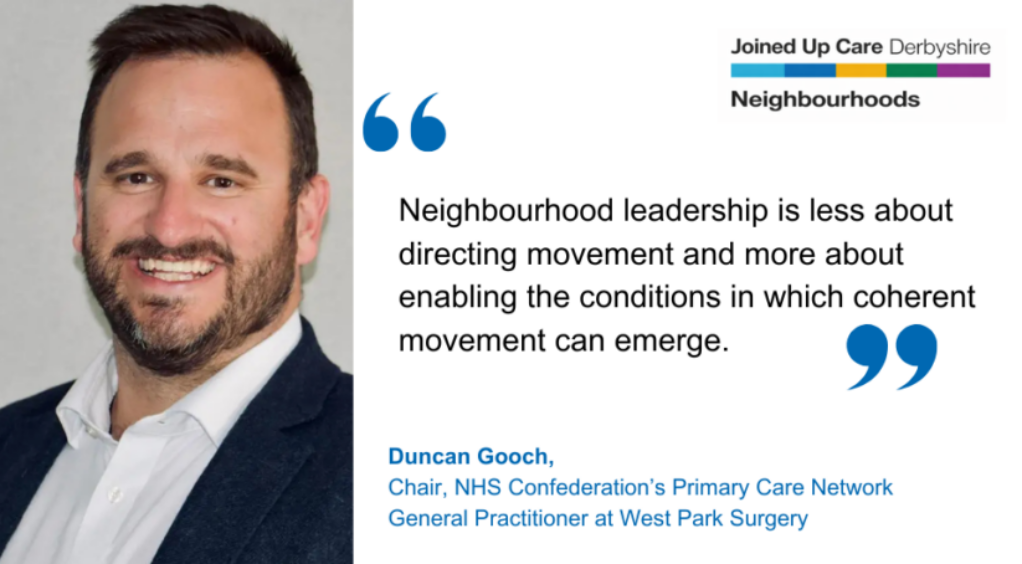
Neighbourhood leadership is less about directing movement and more about enabling the conditions in which coherent movement can emerge.
- Less command and control.
- More alignment and trust.
- Less dominance.
- More distributed leadership.
If we get that right, neighbourhoods won’t descend into chaos.
They’ll become adaptive.
And that’s exactly what the future demands of us.