
Leading Differently: Neighbourhood models will create the seamless service patients already expect
Dr Richard Butler
Richard Butler is a long‑standing GP partner in Eckington and the neighbourhood clinical lead for North East Derbyshire and Bolsover. His leadership is grounded in collaboration, trust and shared purpose. He believes neighbourhood working strengthens relationships, improves system understanding and ultimately delivers more coordinated, compassionate care for local residents.
- What are the key aims in your area of neighbourhood working?
The key aim of neighbourhood working in our area is to rebuild and strengthen relationships between organisations so we can deliver genuinely joined‑up, person‑centred care. Over time, services became more centralised and the natural connections between general practice, community teams and social care weakened. Neighbourhood working gives us a structure to reconnect those teams, build trust and develop a shared understanding of local needs. By creating an inclusive space where every partner feels valued, we can design care that is more coordinated, responsive and effective. Ultimately, the aim is simple: better outcomes for residents through stronger collaboration and clearer communication.
- What is your style of leadership and why did you choose it?
My leadership style is fundamentally collaborative. I don’t see myself as a traditional, top‑down leader; instead, I focus on creating the conditions where others feel able to contribute, challenge and shape the direction of the group. That approach comes from starting as a member of the alliance before becoming its clinical lead, which made me very conscious of maintaining equality and shared ownership. I facilitate rather than direct, chairing discussions in a way that brings quieter voices in and ensures decisions reflect collective insight. I chose this style because trust, inclusion and shared purpose are essential for genuine partnership working.
- What has been the impact of leading differently for patients and people?
Good neighbourhood leadership helps create services that feel more coordinated and responsive for patients. The home visiting service and the Falls Response Service are good examples — both were enabled by strong relationships and collaborative decision‑making. Patients often assume the system already works seamlessly behind the scenes, but historically that hasn’t always been the case. Neighbourhood working is bringing us closer to that expectation by improving communication and reducing fragmentation. When organisations trust each other and share information more effectively, patients experience smoother transitions, quicker support and fewer gaps. Ultimately, leading collaboratively helps deliver care that feels more joined‑up and humane.
- What impact are you most proud of creating by leading differently?
I’m most proud of helping to build a genuinely inclusive Neighbourhood Alliance where every organisation feels valued and able to contribute equally. That culture of trust didn’t happen by accident; it took time, consistency and a deliberate effort to bring people together. The strength of those relationships became clear during COVID, when we mobilised quickly around vaccine inequality and coordinated support for vulnerable residents. The Alliance became the engine room for local action, showing that when people feel safe, respected and heard, they work differently. Leading collaboratively created a space where shared purpose could translate into real, tangible outcomes.
- What would an old way of leading have looked like and what was different this time? Why was this more successful?
Previously, leadership across organisations tended to be more formal, hierarchical and distant from frontline reality. Conversations often happened at senior levels, with limited involvement from the people actually delivering care. That meant decisions could feel abstract and harder for teams to buy into. This time, the approach was deliberately inclusive and relationship‑driven. We brought partners together as equals, created space for honest discussion and ensured everyone could shape priorities. That shift made the work more successful because people felt genuine ownership. When colleagues see their insight reflected in decisions, commitment grows, collaboration strengthens and solutions become more grounded in real need.
- How did your thinking change from working on a smaller scale to working more across the system?
Working at neighbourhood level has fundamentally broadened my perspective. When you operate solely within a single practice or PCN, your focus is naturally on immediate pressures and the needs of your own patients. Moving into system‑level work forces you to step back and understand how interconnected everything is — how decisions in one part of the system ripple into another. It has made me more aware of the range of services available, the constraints others face and the importance of aligning priorities. That shift has helped me think less about organisational boundaries and more about what genuinely improves outcomes for residents.
- What were your catalysts, drivers, and motivators?
My main catalyst has always been seeing the gaps patients experience when services don’t connect well. Working in general practice, you see first‑hand how fragmented the system can feel, and that motivated me to get involved in work that brings organisations closer together. Another driver was recognising how much stronger outcomes are when relationships are built on trust rather than hierarchy. I’m also motivated by a genuine belief that neighbourhood working can make care more coordinated and humane. Finally, the energy and commitment of colleagues across sectors has kept me going — seeing others lean in reinforces why this work matters.
- What are the opportunities and challenges of this working?
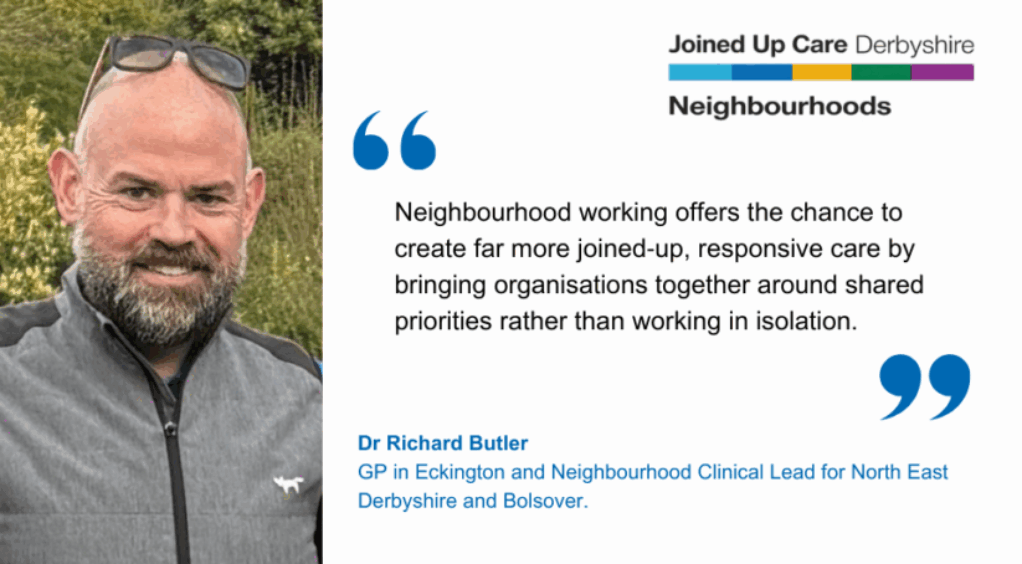
Neighbourhood working offers the chance to create far more joined‑up, responsive care by bringing organisations together around shared priorities rather than working in isolation. It helps reduce duplication, strengthens relationships and gives frontline teams a clearer voice in shaping local solutions. But it also brings challenges: every organisation has its own pressures, cultures and expectations, and aligning these takes time, trust and consistent communication. Capacity is stretched across the system, so releasing people to collaborate isn’t always easy. As neighbourhoods take on more responsibility, managing conflicts of interest will also require honesty and maturity. Despite this, the potential benefits for residents are significant.
- Has your job changed as a result of this?
Yes, my job has changed significantly. Working at neighbourhood level has made me a more rounded GP because I now understand the wider system better — what’s available, how services connect and where the gaps are. That broader perspective helps me make better decisions for patients. But it also creates tension at times, because I’m wearing two hats: neighbourhood lead and GP partner. Sometimes the system perspective doesn’t align neatly with the practice perspective, and navigating that can be challenging. It also takes me away from clinical work at a time when GP capacity is stretched, so balancing both roles requires care.