
Leading Science Journal highlights Derby and Derbyshire’s neighbourhood health model
Derby and Derbyshire’s pioneering neighbourhood model and approach to integrated, place‑based care has been spotlighted in Public Health, the journal of the Royal Society of Public Health.
The Team is developing an integrated, neighbourhood‑based model of health and care that aligns with the NHS 10‑year plan’s ambition for a single, co‑ordinated, patient‑orientated service.
The article: Teaming up for improved population health: A model for whole system integration was penned by Dr Laura French, Director of Population Health Management, Jim Austin CEO Derbyshire Community Health Services, Dr Penelope Blackwell, GP and chair of the Neighbourhood Executive, and Nicki Doherty, Director of Place and Partnerships. It describes the Derby and Derbyshire advances in neighbourhood health, in the context of the increasing complexity of population health need and pathway fragmentation. This often leads to patients feeling disempowered and healthcare professionals feeling siloed and frustrated.
The NHS plan recognises that the current system works least well for those already experiencing the poorest outcomes, reinforcing the inverse care law and the need for more collaborative, place‑based approaches. There is also national guidance expected for neighbourhoods, and we will aim to take this good work and align to the guidance where appropriate.
Derby and Derbyshire have been early leaders in neighbourhood working, with 18 integrated neighbourhood teams operating across Primary Care Network footprints.
These teams are supported by a Neighbourhood Executive with devolved responsibility from the Integrated Care Board, enabling local decision‑making, shared budgets and distributed leadership. A flagship programme, Team Up, provides wraparound care for housebound people and those experiencing frailty. In 2022/23 it delivered over 24,000 visits, reduced ambulance callouts by 2,300 and cut short hospital stays by 1,400. The model’s innovation lies in bringing together preventative, urgent and reactive care to address a wide range of needs in a coordinated way.
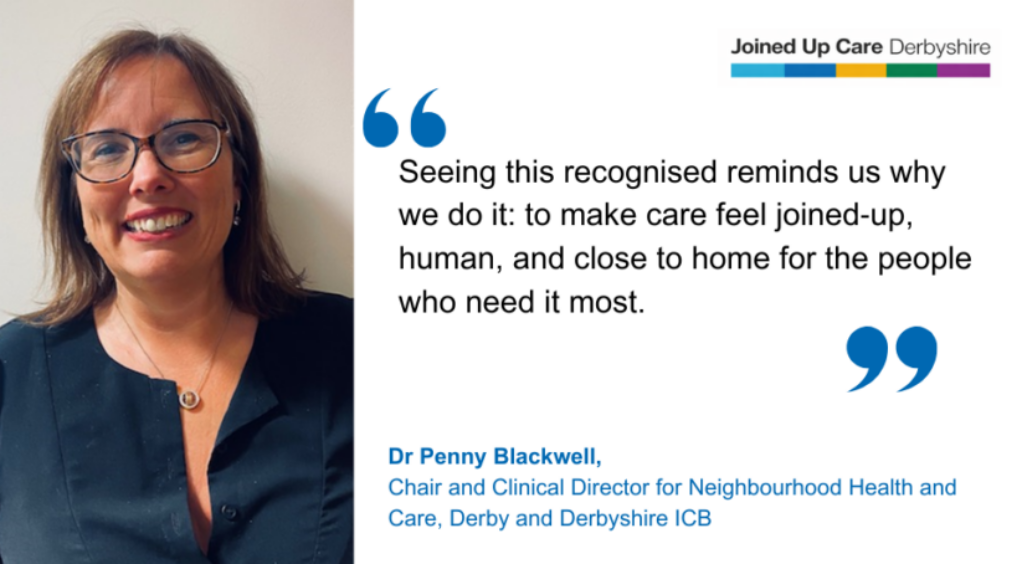
Dr Penny Blackwell said: “I’m really pleased to see our neighbourhood work highlighted because it reflects what teams across Derby and Derbyshire are doing every day. This approach only works because people are willing to show up for each other across organisations, sit alongside communities, and design support that actually fits people’s lives. Seeing that recognised reminds us why we do it: to make care feel joined‑up, human and close to home for the people who need it most.”
The neighbourhood model incorporates a broad suite of services, including acute home visiting, urgent community response, enhanced health in care homes, anticipatory care, discharge pathways and personalised care planning. Multi‑disciplinary team meetings and proactive follow‑up after hospital discharge ensure continuity and coordination. The approach also connects people to voluntary and community organisations for issues such as debt, housing, isolation and daily living challenges.
Population Health Management (PHM) is one of the core principles underpinning the model. This includes the strategic use of data, insight and intelligence to guide decision making, and understanding the importance of the environments in which people live, work and socialise when it comes to health and wellbeing. Derby and Derbyshire are early adopters of the Federated Data Platform’s strategic commissioning tool, which will integrate national and local datasets – including wider determinants of health – to identify unwarranted variation and support proactive care.
Community engagement and co‑production are central. A community‑led insight framework, “Listening, Learning and Taking Action Together,” helps embed lived experience into service design and track progress across five domains of community involvement.
Looking ahead, the system plans to expand neighbourhood health hubs, integrate physical and mental health services, strengthen community care and discharge pathways, and develop shared metrics to measure impact. The overarching aim is a proactive, targeted, person‑centred system that delivers care “in the places and ways which matter” to local communities.
The article will be readable on open access until the end of April, after which, it will be available to subscribers of the Journal of Public Health or via an institutional Athens login. Find out more about Team Up.