
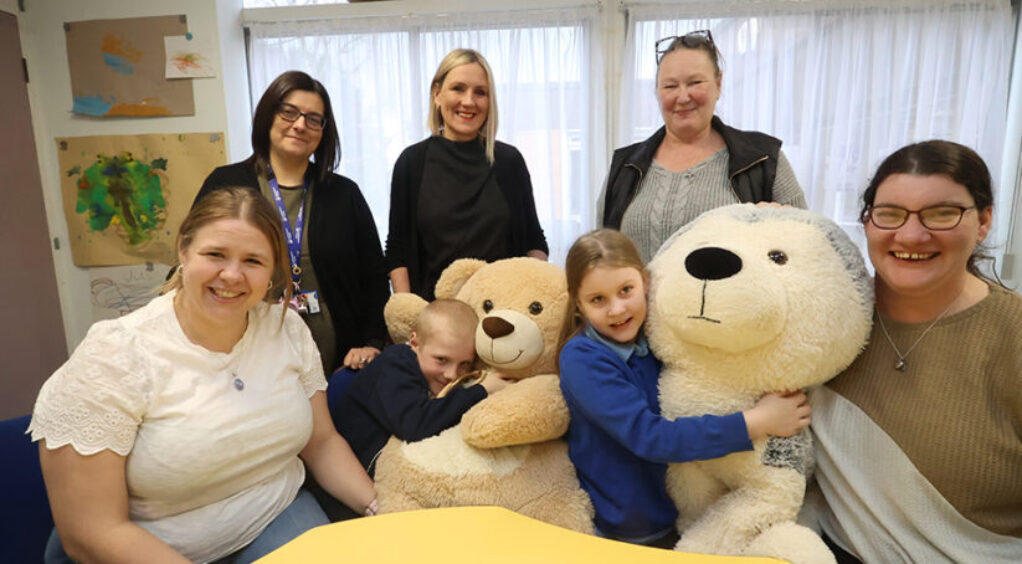
“Our children are included and they are thriving”
Children at a Derbyshire school that took part in the Partnership for Inclusion of Neurodiversity in Schools (PINS) project are now thriving, their parents and teachers have said.
The inclusive teaching at Holme Hall Primary School in Chesterfield has enabled children who previously had a poor learning experience to benefit from full participation in lessons and activities.
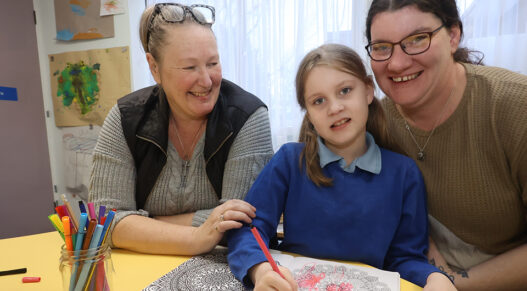
Teaching assistant Caz Taylor left, Leigh-anne Ludditt right and Annabelle
Leigh-anne Ludditt, whose daughter Annabelle, aged eight, was previously on a very limited timetable at her infant school, said: “I cannot explain how proud I am of her achievements.
“Annabelle used to be partly non-verbal but she has developed and now we can have full conversations.
“Bringing her here was the best decision ever. The school explained how they would support her. They wanted her to do a full timetable and it has made her happy. She’s included.
“Children who have additional needs deserve their education in the same way as any other child.”
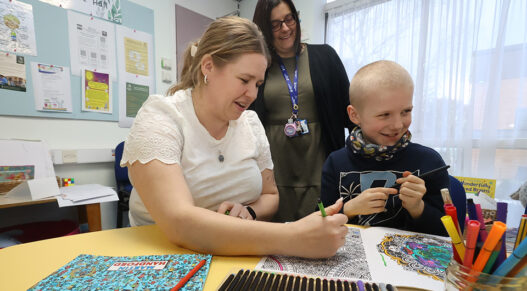
Lindsay Hall left, pastoral lead Helen Fowler centre and Elliot
Lindsay Hall’s son Elliot, aged nine, was attending his previous school just three hours a day, he had been suspended several times and was on the verge of being permanently excluded when he moved to Holme Hall School.
Lindsay said: “Elliot is doing amazingly well. He can be himself. He just keeps thriving and that is what I want for him.
“Previously he couldn’t manage his emotions. He would throw things – oranges, apples, books. The teachers had to evacuate the class and I felt bad for everyone around him.
“Then I changed jobs to help me to look after him and I decided to try this school.
“They made me feel at ease, they nurtured Elliot and supported him and now he is so much better with his emotions. He is on a full-time timetable and he is succeeding.
“He says to me now that he loves school. He has a good relationship with the teachers and with his friends.”
School headteacher Jackie Littlechilds took part in the PINS training, together with Special Educational Needs Coordinator Holly Hinitt, and they shared their learning with the staff team of 20 teachers, teaching assistants and support staff.
The training included sessions from Derbyshire County Council’s Inclusion Support and Advisory Service, led by teaching experts and an educational psychologist.
The school also held two “listening sessions” with Derbyshire Parent Carer Voice to hear parents’ experiences of bringing up children with SEND and supporting them through school.
Jackie said: “We decided to take part because we were noticing more children coming to us with additional needs and we felt ill equipped to support them as well as we wanted to.
“We know that all children need to be included – to feel that sense of belonging which allows them to thrive.
“The PINS project helped us see things through a neurodiversity lens and this has given us the confidence to follow our hearts and do everything we can to meet the needs of all our children.
“The workshops and webinars have helped us to develop a deeper understanding of the neuroscience behind some of the responses we see, and given us a wide range of practical strategies to put into practice which has enabled us to support our neurodiverse children and their families as we continue to build our culture of inclusivity and kindness at Holme Hall.”
Changes the school has introduced include:
- using positive language to talk about neurodiversity, to celebrate difference, individuality and everybody’s strengths
- understanding how neurodiverse children are affected by the environment they are in
- changing classroom displays and environments, so they are consistent and do not risk distracting or over-stimulating children
- introducing soft lighting and sensory corners of classrooms where children can take a break from the stimulation of being at a desk
- having a basket of “concentration aids” available in class for anyone
Jackie said: “We looked at the classroom spaces through children’s eyes. They were too busy, there was far too much going on, too much on the surfaces.
“It meant the children couldn’t concentrate on just one thing.
“So we took down the bright colours and made the displays consistent.
“That means children move from one classroom to another without feeling anxious because of the change in environment and they can slip straight into learning.”
For children and their parents the school’s inclusive culture is also obvious outside the classroom.
Lindsay said: “At other schools I always felt like I was being judged – they looked at my child as being naughty.
“But this school is warm and welcoming.
“Elliot is able to go to the school disco now and to go on their residential trip, which would have been impossible before.
“He is able to take part in assemblies, he is able to take feedback and marking of his work, whereas previously he would have a meltdown at being told he had got something wrong.”
Leigh-anne added: “In the previous school Annabelle would sit under the table and she would scream, so I had to come and collect her.
“For two years she was on a limited timetable and she felt left out and different. She wanted to be at school, but she was struggling to manage it.
“Now I can drop her off knowing she’ll be OK for the rest of the day.
“She will travel on school trips too together with the other children, whereas at the previous school I had to accompany her. She’s part of the class now.”