
Leading differently in neighbourhoods: “Housing, income, safety, community – that’s where the real change happens”
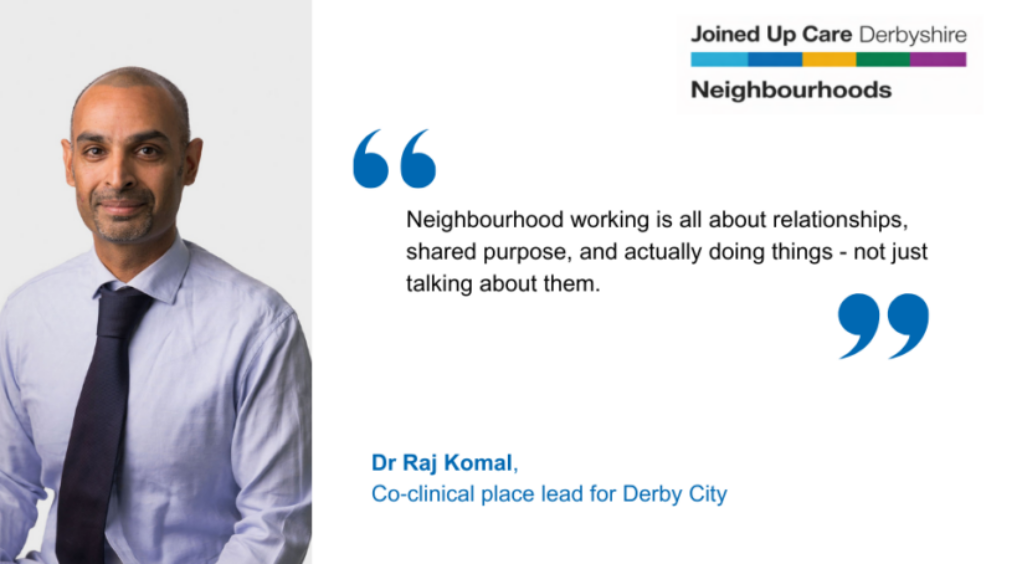
Dr Raj Komal, co‑clinical place lead for Derby City
Dr Raj Komal is a GP partner at Wilson Street Surgery in Derby City and the co‑clinical place lead for Derby City. With more than 15 years of experience in system‑wide working, he has been at the heart of Derby’s neighbourhood development from its early days. His leadership has helped bring together health, social care, the voluntary sector, and local authority partners to build a more holistic, community‑driven approach to improving health and wellbeing. Raj’s work – particularly around infant mortality – shows how collaborative neighbourhood models can create meaningful change for patients, families, and frontline professionals.
- What are the key aims in your area of neighbourhood working?
Our main aim is pretty simple: get the right people round the table so we can actually improve the lives of people in Derby City. We’ve spent the last few years figuring out what really matters to our communities, and that’s how we landed on Start Well, Stay Well, and Age Well. Each of those has proper workstreams behind them, not just ideas on paper. What’s changed is that it’s no longer just health doing its own thing — we’ve got the council, voluntary groups, social care, PCNs, everyone. When you bring all those voices together, you start to see gaps you didn’t know existed and strengths you didn’t know you had. It’s a much more focused, practical way of working, and it means people get support that actually fits their lives, not just a medical label.
- What is your style of leadership and why did you choose it?
I’ve always been someone who leads from the front. If there’s a job to do, I’ll roll up my sleeves and get stuck in – that’s how you build trust. But alongside that, I’m big on making sure everyone has a voice. There’s no point bringing people into a room if you’re not going to listen to them. Every organisation has its own pressures and priorities, and sometimes you only realise you’ve got it wrong when someone says, “That’s not how we do things.” You have to sit back and listen. I’ve made plenty of mistakes along the way, but that’s part of it. When people see you’re genuinely trying, and you’re not speaking in NHS jargon, they come with you. That’s why this style works – it’s honest, practical, and it brings people along rather than pushing them.
- What impact am I most proud of creating by leading differently?
The thing I’m most proud of is the strength of the relationships we’ve built across Derby. We’ve now got proper, genuine links between the council, voluntary sector, PCNs, midwifery, health visiting, housing, public health. We meet regularly, we talk honestly, and we’re all at the end of an email for each other. If someone hits a barrier, we don’t shrug and say “not my bit” anymore – we get round the table and sort it. That shift alone has changed the feel of the whole system.
But the standout piece of work for me is the infant mortality programme. Derby has had stubbornly high rates for years, and we knew we couldn’t keep doing the same thing and expecting different results. So we brought eight or nine agencies together and agreed a shared set of principles – genuinely shared. Everyone committed to putting women and families at the centre, looking at the whole picture, and tackling the social factors that sit behind poor outcomes.
The work is much more holistic now. We’re identifying risks earlier, doing proper wraparound assessments, and looking at everything from mental health and domestic safety to mould in the home, finances, diet, diabetes in pregnancy, and substance use. There’s a real recognition that these things matter just as much as the clinical side.
We’ve also been really intentional about our KPIs. We’re tracking:
- Earlier booking into maternity services (so we can spot risks sooner and get support in place before things escalate)
- Increased uptake of smoking cessation support (a huge factor in infant outcomes)
- Improved access to mental health and social support (because stress, safety, and stability massively influence pregnancy)
- Better continuity of care (women seeing the same people, not repeating their story ten times)
- Reduction in late presentations (a big issue historically in Derby)
- Use of the postnatal assessment template across all practices (we’re tracking how many surgeries are using it and how consistently)
- A measurable reduction in infant mortality rates over time (the long‑term goal, even though we know it takes years to shift)
It feels like we’re finally building something that works for them, not for the system.
- What would an old way of leading have looked like, and what was different this time? Why was this more successful?
The old way was very top‑down. CEOs would meet once a month, everyone would bring their own agenda, and it was more about strategy than action, and what each organisation could get out of it. This time it’s completely different. We’ve got social prescribers, care coordinators, GPs, CEOs, voluntary groups – everyone – involved in the workstreams. People naturally get pulled into the bigger picture because they’re already shaping the practical stuff. We’ve stopped pretending any one organisation can fix things alone. We’ve tried that for years and it hasn’t worked. This approach works because it’s built on relationships, honesty, and a shared purpose.
- How did my thinking change from working on a smaller scale to working across the system?
I’ve done system work for a long time, but what’s different now is how deeply non‑health partners are involved. It’s pushed me to think much more in terms of psychosocial and medical solutions together, not separately. You start to realise that 70% of what makes people unwell isn’t medical at all. Housing, income, safety, community – that’s where the real change happens. And when you see how much pressure it takes off GPs and frontline teams, it just makes sense. It’s also made me more aware of language. If you talk in NHS acronyms, people switch off. When you explain things properly and show the benefits, people step up.
- What were my catalysts, drivers, and motivators?
My biggest driver has always been improving patients’ lives. We all know a holistic approach works better, and that’s what keeps me going. The neighbourhood model itself has been a huge catalyst – suddenly you’ve got everyone round the table, discovering services you didn’t even know existed. It’s like putting together a jigsaw you didn’t realise you had all the pieces for. And when you see how much easier it becomes for patients to get the right support, it motivates you even more. Even now, I still meet people and think, “I had no idea your service did that.” That’s the exciting part – realising how much more we can offer when we work together.
- What are the opportunities and challenges of this working?
The opportunities are massive. We can give patients more holistic care, reduce GP workload, and make referrals smoother and quicker. It also helps us design services that actually reflect what communities need, not what we assume they need. But the challenges are real too. There’s so much happening across the city that keeping track is tough. Different organisations speak different languages and work at different speeds. And proving impact is hard – the real benefits often take years to show, but we work in yearly cycles. We’re trying to use KPIs like earlier maternity booking, smoking cessation uptake, and postnatal assessments to show progress. But some of the biggest wins are softer – like how easy it is now to get someone into the right service.
- Has my job changed as a result of this?
Definitely. I’m much more aware of what’s out there for patients, which means I can offer support that goes way beyond the medical issue. I’m constantly referring people to social prescribers, local area coordinators, voluntary groups – and it works. We meet with PCN leads every month so practices stay up to date. The challenge is remembering everything when you’re busy, but that’s why having social prescribers is so helpful. You don’t need to know every service – you just need to refer them to the social prescriber. It’s changed how I think and how I work, and it’s made my consultations more holistic and more effective.
- What has been the impact of leading differently for patients and people?
Patients are getting support that actually fits their lives. It’s a win when people don’t need to come back to the GP because their needs are met elsewhere – and that’s a good thing. They feel heard, supported, and connected to their community. And for women in the infant mortality programme, the difference is huge. They’re getting earlier support, more consistent care, and a team around them instead of being left to figure things out alone. We’re seeing better engagement, better continuity, and better outcomes. And the nicest bit is when people don’t come back because they’re genuinely doing better.
Neighbourhood working is all about relationships, shared purpose, and actually doing things – not just talking about them. It’s about listening properly, understanding each other’s roles, and keeping patients at the centre. When we work together honestly and practically, the system becomes more compassionate, more effective, and more sustainable. And most importantly, people start to trust it again. That’s what really matters.