
Celebrating social prescribers transforming lives across Derbyshire
We’re celebrating national social prescribing day today (Thursday) with a deep dive into some of the teams and schemes helping thousands of people in Derbyshire.
Social prescribing is already changing lives across Derbyshire.
In Bolsover, people have overcome long term isolation by joining walking groups and community activities.
In Derby, young adults with severe anxiety have started volunteering in community cafés, building confidence that has led to education and work.
In the High Peak, carers have accessed respite and rebuilt their wellbeing.
In the South Dales, older residents have found new purpose through arts groups, exercise classes and social clubs.
In Chesterfield, social prescribers have helped people in crisis find safe housing and stabilise their lives.
A new training programme to increase professional development and give social prescribers access to peer support began this year funded by the Hub + Derbyshire.
The year-long initiative aims to strengthen peer support, improve wellbeing and highlight the impact the region’s 80-plus social prescribers make every day.
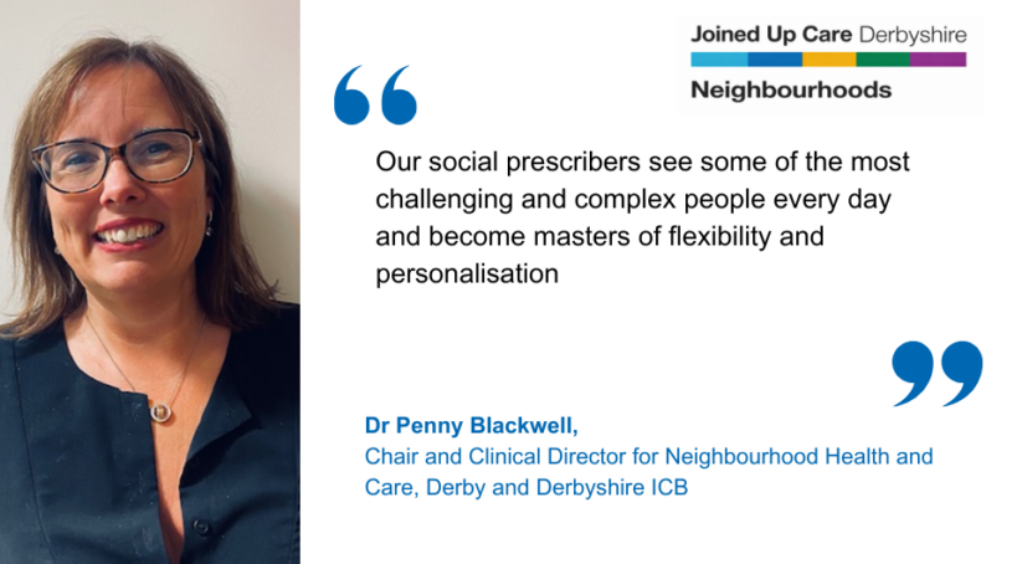
Dr Penny Blackwell, Chair and Clinical Director for Neighbourhood Health and Care, Derby and Derbyshire ICB, said: “We know that 70% of our health concerns arise due to the wider determinants of health, such as loneliness and isolation, poor housing, inactivity, access to employment and education, financial constraints. Our social prescribers manage all of these and more, seeing some of the most challenging and complex people every day and become masters of flexibility and personalisation.”
Social prescribers work with anyone over 18 who need help with the non medical issues that shape health – housing, finances, caring responsibilities, loneliness, chronic pain, or simply the confidence to re enter community life.
A small team in the South Dales have supported thousands of people to improve their health and wellbeing and saved as many as 7,000 GP appointments.
Working across four GP practices, the team has seen more than 2,400 people over the last six years, with referrals coming from GPs, care coordinators, health visitors, occupational therapists and mental health teams. They have helped residents rebuild confidence, connection and independence, reduced pressure on GP practices and cut hospital admissions.
The team are based at Derbyshire Dales CVS in Bakewell. Zoe Beesley, social prescribing development worker, said: “We support individuals with any issue which is influencing their overall health and wellbeing which isn’t a medical concern.
“We often support individuals who are experiencing a multitude of difficulties at one time.
“Often a simple referral can lead to the social prescribing team supporting the client with multiple, often complex issues.
“Social prescribers have the time to listen, carry out home visits and focus on ‘what matters to me’ in order to support the individual to identify what they would like to be different and support them in making those changes.”
The team’s caseload reflects the diversity of the South Dales. In some areas, they see more older people and carers, in others, younger adults facing housing instability, addiction or financial hardship. Increasingly, mental health is a common thread.
The team is soon to disband but over the six years they have developed 12 projects and peer support groups.
“There are a lot of mental health issues which need support but by us helping them early in a preventative way we can stop escalation to mental health services,” said social prescribing development worker Debbie Rushworth. “It’s getting to the root cause of what’s causing those issues.”
Unlike many overstretched services, social prescribers can spend time with people – visiting them at home, helping them navigate forms, accompanying them to groups, or simply working through barriers that stop them moving forward.
“We can be that person who walks through the door with them the first time,” said Debbie. “It’s that time and that ability to look at the barriers with them that makes a massive difference.”
When referred, the person has a what matters to me conversation and then could receive a home visit and time to talk before building a plan to reach their goals.
From January 2023 to December 2025, data shows they supported 584 people in the South Dales and 856 in the north receiving 1440 referrals.
For the 30% of cases where full outcome data is available:
- GP appointments reduced by 26%
- Hospital admissions reduced by 65%
- Sick notes reduced by 49%
Financial modelling suggests that reductions in GP appointments alone saved up to £407,000 over two years with up to 7,000 GP appointments avoided.
Social prescribing development worker Rachel Metcalfe supported an elderly couple who initially seemed to have everything in place – stairlifts, equipment, a strong professional background. But beneath the surface, they were struggling.
“They didn’t know about attendance allowance. They didn’t know about carer support,” Rachel said. Over seven to eight months, she helped them access benefits, emergency carer support and eventually regular care visits.
“The change was profound,” she said. “When he did feel a bit better, they went out together just to the local church and he said “you’ve given us a new lease for life.
Zoe helped a man with chronic pain who had been visiting his GP almost weekly.
“Since engaging with sessions and getting more tools to manage his condition he’s massively reduced his visits to the surgery,” she said.
Debbie helped a man whose wellbeing score rose from 6% to 91% after sudden hearing loss left him isolated and repeatedly attending minor injuries for help.
“We got him a smartphone so when he was talking to somebody, it would write down the conversation for him,” she said. With attendance allowance, daily support visits and better communication tools, he became much more independent.
“He had felt like there was no reason to carry on but suddenly he could interact with the world again and he started to enjoy things much more.”
“It’s just knowing that you’ve made their life a little bit better,” said Rachel. “Those small little steps that you can support them with really.”
If you’re interested in social prescribing please speak to your GP.